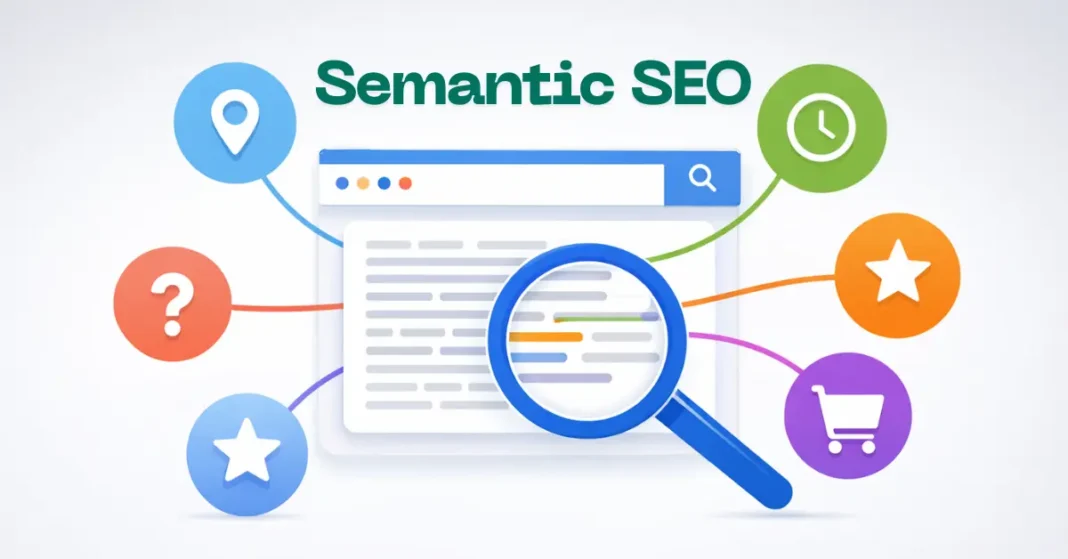
Semantic SEO is how Google understands the meaning and context behind your content, not just individual keywords. If you’re running a business in Bangladesh and wondering “what is semantic SEO,” you’re not alone. Many business owners hear this term and feel confused.
Let me explain it in the simplest way possible.
Think about how you talk to a friend. When you say “I need a doctor,” your friend understands you’re looking for medical help. They don’t just hear the word “doctor.” They understand the context, your intent, and what you actually need.
This is exactly how Google works with semantic search optimization in 2026.
Understanding Semantic SEO: What Does It Actually Mean?
Semantic SEO means optimizing your content so Google understands what your page is really about, not just which keywords you used.
Let me give you a real example from Bangladesh.
Imagine someone searches “best biryani near me” in Dhaka. Google doesn’t just look for pages that repeat “best biryani” multiple times. Instead, Google understands:
- The person wants restaurant recommendations
- They’re looking for local options
- They probably want reviews, prices, and locations
- They might also want photos of the food
- They need directions to get there
Google shows results that answer the complete intent, not just pages stuffed with the keyword “best biryani.”
This understanding of meaning and context is what semantic SEO is all about.
Traditional Keyword SEO vs Semantic SEO: What’s the Difference?
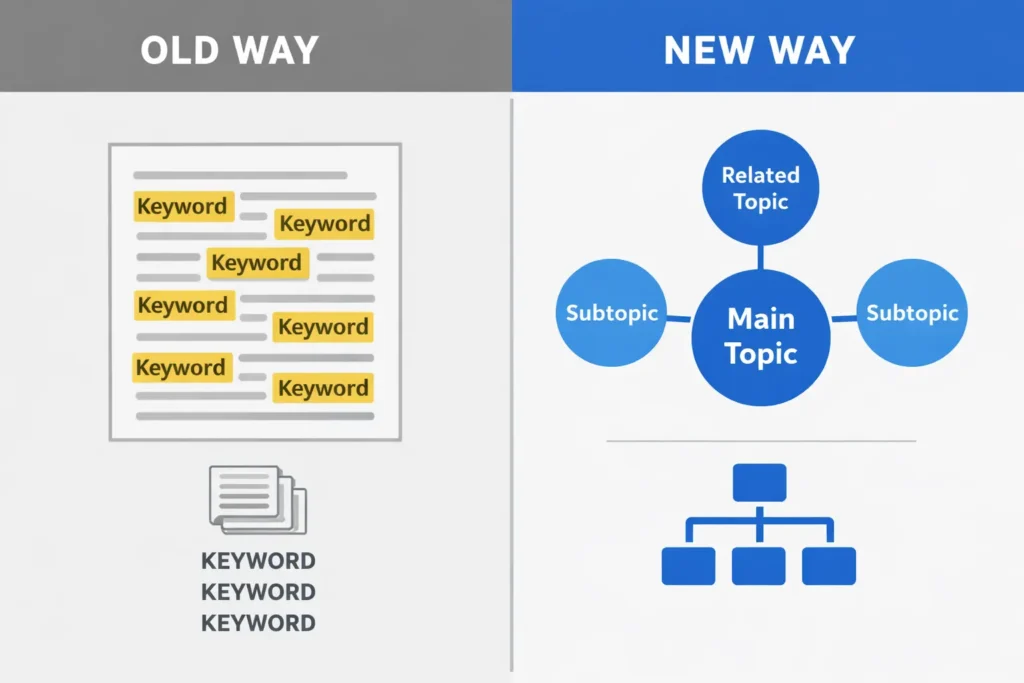
Let me show you the difference with a simple comparison.
Old Way (Keyword SEO):
You’re selling furniture in Chittagong. You write:
“Buy furniture in Chittagong. We sell furniture in Chittagong. Our Chittagong furniture store has cheap furniture. Chittagong furniture delivery available.”
This sounds robotic and unnatural. You’re just repeating keywords, hoping Google will rank you.
New Way (Semantic SEO):
Same furniture business, but you write:
“Looking for quality home furniture in Chittagong? We offer sofas, dining sets, and bedroom collections with free delivery across the city. Our showroom in Agrabad displays over 200 pieces, and we provide custom measurements for apartments and houses.”
Notice the difference? The second version:
- Sounds natural and helpful
- Answers real questions (what products, where is showroom, do you deliver)
- Uses related terms (sofas, dining sets, bedroom collections)
- Provides useful details (location, number of items, custom service)
- Covers the complete topic
Google now understands your page is about furniture shopping in Chittagong without you repeating the exact phrase ten times.
How Google Understands Semantic Meaning
Google uses artificial intelligence to understand content as humans do. The main technology is called BERT, which helps Google understand natural language.
Here’s what Google looks for:
1. Topic Relevance Google checks if your entire page covers the topic completely. If someone searches “how to start an online business in Bangladesh,” Google wants to see:
- Business registration steps
- Payment methods (bKash, Nagad, bank)
- Popular platforms (Daraz, Facebook, own website)
- Delivery solutions
- Legal requirements
2. Related Concepts Google knows that certain words belong together. For a restaurant page, Google expects to see:
- Menu
- Location
- Hours
- Reviews
- Reservations
- Food photos
3. User Intent Google understands what people actually want. When someone searches “iPhone price Bangladesh,” Google knows they want:
- Current prices
- Available models
- Where to buy
- Official vs unofficial markets
- Warranty information
4. Context and Relationships Google understands how concepts connect. If your page mentions “Walton refrigerator,” Google knows this relates to:
- Home appliances
- Bangladeshi brand
- Electronics
- Warranty service
- Energy efficiency
Real Semantic SEO Examples from Bangladesh
Let me show you practical examples you can understand.
Example 1: Local Restaurant
Bad approach (keyword stuffing): “Best restaurant in Dhanmondi. Dhanmondi restaurant. Food in Dhanmondi restaurant. Visit our Dhanmondi restaurant.”
Good semantic approach: “Our Dhanmondi location serves authentic Bengali cuisine including hilsa curry, beef bhuna, and fresh roti. We’re open daily from 12 PM to 11 PM at Road 27, near Rabindra Sarobar. Delivery available through Foodpanda and Pathao Food.”
Why this works:
- Mentions specific dishes (semantic context)
- Includes operating hours (answers user questions)
- Provides exact location (helps local search)
- Lists delivery options (covers user needs)
Example 2: Clothing Store
Bad approach: “Buy sarees online Bangladesh. Sarees Bangladesh. Bangladesh saree shop online.”
Good semantic approach: “Shop cotton sarees, silk sarees, and jamdani designs with nationwide delivery. We offer cash on delivery across Dhaka, Chittagong, and Sylhet. Prices range from 2,000 to 50,000 taka with detailed size guides and return policy.”
Why this works:
- Specifies product types (cotton, silk, jamdani)
- Mentions delivery method (cash on delivery)
- Includes price range (answers budget questions)
- Covers practical details (size guides, returns)
Example 3: Educational Service
Bad approach: “IELTS preparation Dhaka. IELTS coaching Dhaka. Best IELTS Dhaka.”
Good semantic approach: “Prepare for IELTS with experienced British Council certified trainers. Our 8-week program covers all four modules: listening, reading, writing, and speaking. Classes available in Dhanmondi and Uttara with flexible morning and evening batches. Free mock tests included.”
Why this works:
- Explains credentials (British Council certified)
- Details course structure (8 weeks, four modules)
- Lists locations and timings (answers practical questions)
- Mentions value addition (free mock tests)
Why Semantic Search Optimization Matters for Your Business
You might wonder, “Why should I care about this?”
Here are the real benefits for businesses in Bangladesh:
1. Better Rankings Without Keyword Stuffing
You can write naturally and still rank well. No need to force keywords awkwardly into every sentence.
2. Matches How People Actually Search
More people in Bangladesh use voice search and natural questions like “Dhaka te bhalo computer kothay pabo?” (Where can I find good computers in Dhaka?). Semantic SEO optimization helps you rank for these conversational searches.
3. Reduces Competition
Instead of fighting for one exact keyword, you rank for many related terms. Your furniture store page can rank for “buy sofa Dhaka,” “furniture shops in Dhaka,” “where to buy dining table,” and dozens of related searches.
4. Builds Trust and Authority
When your content fully answers questions, Google sees you as an expert. This is part of what Google calls E-E-A-T (Experience, Expertise, Authoritativeness, Trustworthiness).
5. Future-Proof Your SEO
Google gets smarter every year. Semantic search is how Google already works, so you’re preparing for the future.
How to Start Using Semantic SEO in Bangladesh
You don’t need to be technical to implement semantic SEO. Here are simple steps:
Step 1: Think Like Your Customer
Before writing content, ask yourself:
- What questions do people have?
- What details do they need to make a decision?
- What problems are they trying to solve?
If you run a travel agency, customers want to know:
- Tour packages and prices
- What’s included (hotel, food, transport)
- Best time to visit
- Required documents
- Group size
- Cancellation policy
Cover all these topics naturally in your content.
Step 2: Use Natural, Helpful Language
Write like you’re explaining to a friend. Use the words your customers actually use.
If you sell mobile phones, don’t just list specifications. Explain what they mean:
Instead of: “6GB RAM, 128GB storage” Write: “6GB RAM means the phone runs multiple apps smoothly without slowing down. 128GB storage holds approximately 30,000 photos or 100 movies.”
Step 3: Answer Complete Questions
When someone asks “how to apply for a passport in Bangladesh,” they want:
- Required documents list
- Application process steps
- Fees and payment methods
- Processing time
- Where to collect
- Common mistakes to avoid
Create comprehensive content that answers the complete question.
Step 4: Include Related Topics
If your page is about “learning English in Dhaka,” also mention:
- Course levels (beginner to advanced)
- Class schedules
- Teacher qualifications
- Study materials
- Practice methods
- Success stories
Google understands these are all related to the main topic.
Step 5: Use Proper Structure
Organize your content with clear headings. This helps both readers and Google understand your content structure.
Use:
- H2 for main sections
- H3 for subsections
- Bullet points for lists
- Short paragraphs (2-3 sentences)
Step 6: Add Schema Markup
Schema markup is code that helps Google understand your content better. For a local business in Bangladesh, add:
- Business name
- Address
- Phone number
- Opening hours
- Services offered
You can use plugins like Rank Math or Yoast SEO to add this easily in WordPress.
Common Semantic SEO Mistakes to Avoid
Based on my experience working with over 200 businesses, here are mistakes I see often:
Mistake 1: Still Keyword Stuffing
Don’t repeat your main keyword unnaturally. Write for humans first.
Mistake 2: Thin Content
Don’t create short pages that barely answer the question. If someone asks “best restaurants in Gulshan,” don’t just list 5 names. Provide details about cuisine type, price range, ambiance, specialties.
Mistake 3: Ignoring User Intent
Understand what people really want. “Laptop price Bangladesh” means they want to compare prices and specs, not read a 2000-word history of laptops.
Mistake 4: Using Only English Keywords
Many Bangladeshi users search in Bangla or Banglish (Bengali written in English). Include terms like:
- “bhalo smartphone kothay pabo”
- “sosta laptop Dhaka”
- “online shopping Bangladesh”
Mistake 5: No Local Context
Generic content doesn’t work. Mention Bangladesh-specific details:
- Local payment methods (bKash, Nagad)
- Popular platforms (Daraz, Bikroy)
- Local delivery areas
- Bangladesh pricing
Mistake 6: Copying Competitor Content
Google values original, unique content. Share your own experience and insights.
Measuring Semantic SEO Success
How do you know if semantic SEO is working?
1. Ranking for More Keywords
Check Google Search Console. You should see your page ranking for many related terms, not just your main keyword.
2. Longer Time on Page
When content fully answers questions, people read longer. Check your analytics.
3. Lower Bounce Rate
If people find what they need, they don’t immediately leave. This signals quality to Google.
4. More Organic Traffic
Over 2-3 months, you should see steady traffic growth from various search terms.
5. Better User Engagement
More comments, questions, or contact form submissions mean your content is helpful.
Semantic SEO and Voice Search
Voice search is growing in Bangladesh as more people use Google Assistant and smart speakers in Bangla.
Voice searches are more conversational:
- “Ok Google, Dhanmondi te bhalo biryani restaurant kothay?”
- “Where can I buy fresh vegetables in Uttara?”
- “What’s the best internet package for home?”
Semantic SEO helps you rank for these natural language queries because your content answers complete questions naturally.
Tools to Help with Semantic SEO
You don’t need expensive tools. Here are free options:
1. Google Search Type your topic and look at:
- “People Also Ask” questions
- Related searches at the bottom These show you what else people want to know.
2. Google Search Console Shows which queries bring traffic to your site. Look for patterns and related terms.
3. Answer The Public Free tool that shows common questions people ask about your topic.
4. Your Customer Questions The best source is your actual customers. What do they ask on phone calls, emails, or Facebook messages? Answer these in your content.
Real Results from Semantic SEO
Let me share actual results from my work in Bangladesh.
When I worked with Pet Zone BD, we shifted from targeting just “pet food Bangladesh” to creating comprehensive content covering:
- Different pet types (dogs, cats, birds, fish)
- Specific food brands and ingredients
- Feeding schedules and portions
- Health and nutrition advice
- Local availability and pricing
Over 24 months, their organic traffic increased significantly because they ranked for hundreds of related searches, not just one keyword.
Similarly, with Infinity Pool, we focused on semantic optimization around swimming pool services. Instead of repeating “swimming pool Singapore,” we covered:
- Pool design types
- Maintenance requirements
- Chemical treatment
- Cost estimation
- Safety features
- Local regulations
They went from zero visibility to 700+ monthly visitors in 90 days.
Semantic SEO for Different Business Types
For Restaurants:
Cover menu items, ingredients, ambiance, location, parking, delivery, payment methods, dietary options (vegetarian, halal), portion sizes, and chef background.
For E-commerce:
Include product variations, sizes, colors, materials, usage instructions, care tips, shipping details, return policy, customer reviews, and comparison with similar products.
For Service Businesses:
Explain service process, time required, pricing structure, required documents, booking process, cancellation policy, service area, team qualifications, and case studies.
For Educational Institutions:
Detail courses offered, admission requirements, fees, class schedules, teacher qualifications, facilities, success rates, student testimonials, and scholarship options.
The Future of Semantic SEO in Bangladesh
As internet penetration grows in Bangladesh, more people are searching in natural language. The rise of voice search and mobile usage means semantic SEO will become even more important.
Google’s AI is getting better at understanding Bangla searches. Businesses that optimize for semantic search now will have a significant advantage.
The key is simple: create genuinely helpful content that answers real questions. Stop thinking about “keywords” and start thinking about “topics” and “user needs.”
Getting Started Today
You don’t need to change everything overnight. Start small:
Week 1: Review your most important page. Does it answer all related questions? Add missing information.
Week 2: Check what questions customers ask. Create content that answers them comprehensively.
Week 3: Organize your content with clear structure and headings.
Week 4: Add location-specific details and local context.
Remember, semantic SEO is not a trick or hack. It’s simply about creating truly helpful content that serves your audience completely.
When you do this consistently, Google will reward you with better rankings, more traffic, and ultimately, more customers for your business.
Need help implementing semantic SEO for your business in Bangladesh? As an SEO expert with 10+ years of experience, I’ve helped over 200 businesses improve their search visibility using semantic optimization strategies.
Contact me for a personalized SEO consultation →