Having thousands of Facebook followers means nothing if they don’t actually engage with you.
I’ve seen politicians with 50,000 followers get fewer comments and shares than those with 5,000. The difference isn’t audience size. It’s community building.
I’m Faruk Khan, and over the past decade managing digital presence for organizations across Bangladesh, I’ve learned that followers are just numbers. Community members are people who actively participate, defend your reputation, share your content, and show up when you need support.
This guide shows you how to transform passive followers into an engaged digital community that amplifies your political work.
Why Community Matters More Than Followers
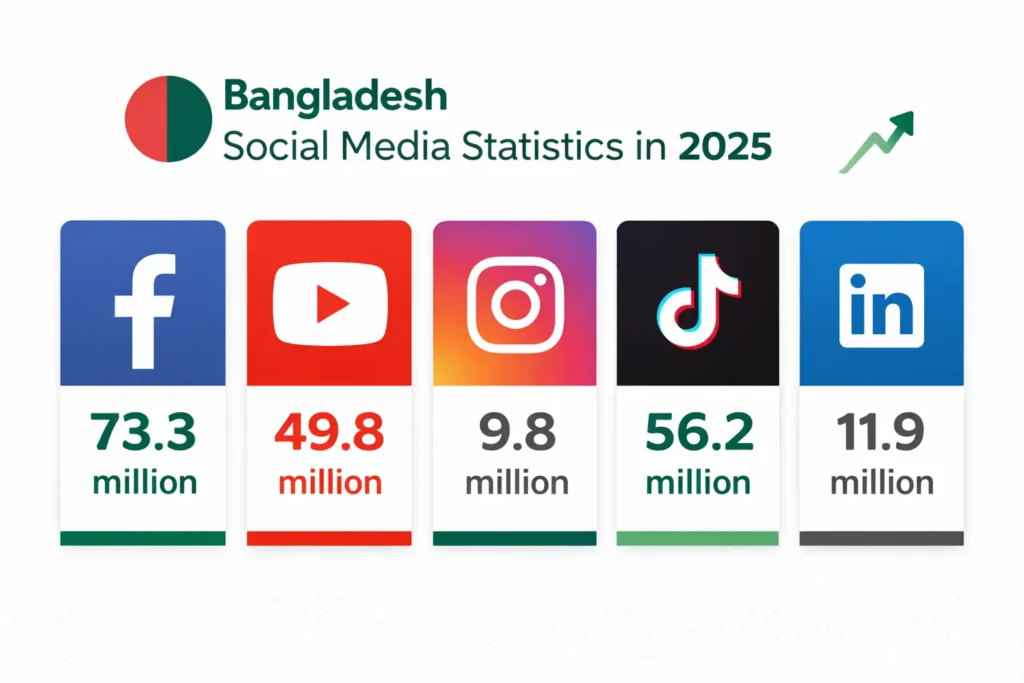
Bangladesh’s social media landscape is massive. Facebook reaches 73.39 million users, TikTok has 56.2 million, and YouTube reaches 49.8 million according to December 2025 data. Millions of Bangladeshis are online, scrolling through endless content.
But most political leaders make a critical mistake. They focus on growing follower counts instead of building genuine communities.
Followers are passive. They might see your posts. They might scroll past them. They rarely take action.
Community members are active. They comment on your posts. They share your content. They defend you when critics attack. They show up at events. They volunteer during campaigns. They tell their friends and family about your work.
The difference determines political success.
Think about it practically. During a campaign, who’s more valuable:
- 10,000 followers who never interact?
- 1,000 community members who actively support you?
The engaged thousand wins every time. They volunteer. They donate. They convince their networks. They vote reliably.
Research shows that engaged community members are worth 10-20x more than passive followers in terms of actual political impact.
Building community takes more effort than collecting followers. But the returns are exponentially higher.
Understanding Engagement in Bangladesh’s Context
Bangladeshi voters engage differently than Western audiences. Cultural factors shape how people interact online.
Respect for authority matters. Bangladeshis generally show more deference to political leaders than Western cultures. This means you need to actively invite participation. People won’t automatically feel comfortable questioning or challenging you publicly.
Family and social networks are powerful. Bangladeshis trust recommendations from family and friends more than advertisements or official statements. Building community means building networks of trusted people who influence others.
Group identity is strong. People identify strongly with their community, region, religion, and family. Content that speaks to group identity resonates more than individualistic messaging.
Face-saving is important. Public criticism or confrontation causes loss of face. Even when disagreeing, most Bangladeshis will phrase it politely or avoid direct confrontation. Understand that silence doesn’t always mean agreement.
Mobile-first interaction is reality. With 98% of Bangladeshis accessing internet via smartphones, engagement happens primarily on mobile devices. Keep this in mind for all engagement strategies.
Language preferences vary. Some voters prefer Bengali, others English, many understand both. Using both languages increases engagement across demographics.
Understanding these cultural factors helps you build community that actually works in Bangladesh’s context.
The Foundation: Accessible and Responsive Presence
Community building starts with being genuinely accessible.
Response Time Matters
When constituents comment or message, how quickly you respond shapes their perception of accessibility.
Facebook shows response time badges. If you respond to messages within hours consistently, Facebook displays “Very responsive to messages” on your page. This encourages others to reach out.
Set realistic expectations. You can’t respond instantly to everything. But establish clear standards:
- Messages: Respond within 24 hours
- Comments on your posts: Acknowledge within a few hours
- Emergency/urgent matters: Within 1-2 hours
Create response protocols. Who on your team handles what?
Example protocol:
- Constituent service requests → Office staff member assigned
- Policy questions → You or senior advisor responds
- General inquiries → Trained team member handles
- Crisis/emergency → Immediate escalation to you
Document these protocols so everyone knows their role.
Quality Over Speed
Quick responses matter, but quality matters more.
Bad response (quick but useless): “Thank you for your comment.”
Good response (helpful): “Thank you for raising this. I’ve noted the issue with streetlights on Station Road. I’ll contact the relevant department tomorrow and update you by Friday on the timeline for repairs.”
The second response takes longer to write but actually helps the person. It also demonstrates accountability by setting a specific timeline you must meet.
Show, Don’t Just Tell
Don’t just promise to be accessible. Prove it through consistent action.
Weekly office hours online. Set specific times when you’re available for direct interaction. “Every Thursday 7-8 PM, I’m live on Facebook answering questions.”
Public follow-ups. When someone raises an issue and you take action, post updates publicly. This shows others that engaging with you leads to real results.
Acknowledge contributors. When community members share useful information or help with issues, publicly thank them (with their permission). Recognition encourages more participation.
Be present in comment sections. Don’t just post and disappear. Spend time reading and responding to comments on your posts.
Accessibility isn’t a one-time thing. It’s consistent behavior over months and years.
Facebook Engagement Strategies
With 73.39 million users, Facebook is where most community building happens in Bangladesh.
Optimize Your Posts for Engagement
The way you write posts affects how people interact.
End with questions. Posts that ask questions get more comments than statements.
Weak ending: “Visited the new school today. Construction is progressing well.”
Strong ending: “Visited the new school today. Construction is progressing well. What other infrastructure priorities should we focus on next in our constituency?”
Questions invite participation. Statements don’t.
Use the “Tag a friend” strategy carefully. “Tag someone who cares about education” can work but feels manipulative if overused. Use sparingly.
Create polls. Facebook’s poll feature makes participation easy. “Which time works better for community town hall: Saturday afternoon or Sunday morning?” Polls get higher engagement than open-ended questions.
Share content that people want to share. Useful information (how to access services, important announcements, helpful guides) gets shared more than self-promotional content.
Post at the right times. Check your Facebook Insights to see when your specific audience is most active. Generally in Bangladesh, evenings (7-10 PM) see high engagement as people finish work and check phones.
Master the Comment Section
The comment section is where community forms.
Respond to early comments quickly. The first few comments on a post set the tone. If you respond to early commenters, it encourages others to participate.
Ask follow-up questions. Don’t just thank people for comments. Engage in actual conversation.
Example: Commenter: “We need better roads in Mirpur.” Weak response: “Thank you for your feedback.” Strong response: “Absolutely. Which roads in Mirpur are the worst? I’m compiling a priority list to present to the city corporation.”
The strong response continues the conversation and invites more specific information.
Handle disagreement professionally. When someone disagrees or criticizes:
- Acknowledge their perspective
- Explain your reasoning
- Avoid getting defensive
- Thank them for engaging
Example: Critic: “Your position on this policy is wrong.” Response: “I understand you disagree. Here’s why I support this approach: [explanation]. I respect that reasonable people can reach different conclusions. What alternative would you suggest?”
Professional disagreement demonstrates maturity and encourages respectful dialogue.
Ignore trolls, engage with critics. There’s a difference:
Trolls: Make personal attacks, aren’t interested in real discussion, just want to provoke Strategy: Ignore or delete abusive comments
Critics: Disagree with your positions but engage substantively Strategy: Respond professionally and respectfully
Feature great comments. When someone makes a particularly insightful comment, respond prominently. This rewards quality participation and sets standards for discussion.
Don’t delete criticism (unless abusive). Deleting every critical comment makes you look afraid of feedback. Leave legitimate criticism up and respond to it. This shows confidence and openness.
Use Facebook Groups Strategically
Facebook pages are for broadcasting. Facebook groups are for community building.
Consider creating a supporter group. This gives dedicated supporters a space to discuss issues, organize activities, and connect with each other.
Group benefits:
- More intimate than public pages
- Facilitates supporter-to-supporter connections
- Easier to organize volunteers and activities
- Higher engagement than pages typically get
Group management:
- Set clear rules about respectful discussion
- Assign moderators to help manage
- Post regularly but let members drive discussion
- Use group for two-way communication, not just broadcasting
Alternative: Join existing community groups. Rather than creating your own, participate in existing groups for your constituency, profession, or interests. This puts you where voters already gather.
Group participation rules:
- Don’t spam every group with political posts
- Contribute value before promoting yourself
- Respect group rules and norms
- Engage authentically, not just politically
Facebook Live for Real-Time Connection
Live video creates immediate, unscripted connection with constituents.
What works for Facebook Live:
Q&A sessions. Announce in advance, then go live and answer questions in real-time. The unscripted nature builds trust.
Event coverage. Live stream from community events, inaugurations, or public programs. This includes people who couldn’t attend.
Breaking news responses. When something important happens affecting your constituency, go live to address it immediately.
Behind-the-scenes moments. Show the reality of political work through live video from your office, parliament, or community visits.
Town halls. Host virtual town halls where you discuss issues and take questions live.
Technical tips for Facebook Live:
Test your setup first. Do a private test to check lighting, sound, and internet connection.
Announce in advance. Post about upcoming live sessions hours or days ahead so people can plan to attend.
Start with context. Begin by explaining what you’ll discuss and how people can participate (comments, questions).
Acknowledge viewers. Say hello to people as they join. Read names from the viewer list.
Engage with comments. Read and respond to comments during the stream. This is what makes it “live.”
Save and share afterwards. The video stays on your page. Share it again later for people who missed the live broadcast.
Keep it conversational. Don’t read from scripts. The power of live video is its authenticity.
Facebook Stories for Daily Connection
Stories appear at the top of Facebook feeds and disappear after 24 hours. This temporary nature allows more casual content.
What works in Stories:
Daily updates. Quick clips from your day, even mundane moments that show you’re working.
Informal announcements. Timely information that doesn’t need permanent posting.
Polls and questions. Stories have interactive features that encourage engagement.
Event coverage. Quick clips from events, giving followers real-time updates.
Behind-the-scenes content. More casual than main feed posts.
Story strategy:
Post daily if possible. Consistency builds habit for followers to check your stories.
Use stickers (polls, questions, quizzes) to drive interaction.
Keep individual story clips under 15 seconds. Attention spans are short.
Add text to make content understandable without sound.
Messenger for Direct Constituent Service
Messenger’s 68.6 million Bangladesh users makes it critical for direct voter engagement.
Setting Up Effective Messaging
Enable instant replies. Set up automatic responses acknowledging messages received.
Example instant reply: “Thank you for contacting our office. We typically respond within 24 hours. For urgent matters, please call [phone number]. Office hours: Sunday-Thursday, 10 AM – 6 PM.”
Use greeting messages. When someone starts a new conversation, they see your greeting message.
Example greeting: “Welcome! How can I help you today? Common requests:
- Constituent services
- Schedule meeting
- Report local issue
- Policy questions
Please describe what you need and we’ll respond shortly.”
Create saved replies. For common questions (office hours, how to access services, meeting requests), create saved replies your team can quickly send.
Tag and organize conversations. Use labels to categorize messages (urgent, general inquiry, complaint, appointment request). This helps manage response priority.
Messenger Response Protocols
Assign responsibility clearly. Someone must check Messenger multiple times daily.
Prioritize by urgency:
- Emergency issues (safety, urgent constituent needs)
- Time-sensitive matters (upcoming deadlines, events)
- General inquiries
- Non-urgent requests
Track requests to completion. When someone asks for help:
- Acknowledge immediately
- Take action on the issue
- Update the person on progress
- Follow up to confirm resolution
Example: Day 1: “I received your message about the streetlight. I’ve contacted the relevant department.” Day 3: “Update: Repair crew is scheduled for Friday.” Day 7: “Just checking – was the streetlight repaired? Please let me know if there are any remaining issues.”
This follow-through builds tremendous loyalty.
Messenger Best Practices
Respond personally when possible. Template responses are efficient but feel impersonal. Add personal touches when you can.
Generic: “Thank you for contacting us.” Personal: “Thank you for reaching out, Mr. Rahman. I appreciate you taking time to inform me about this issue.”
Set boundaries. Make office hours clear. You can’t be available 24/7.
Protect privacy. Never share constituent conversations publicly without explicit permission.
Use voice messages occasionally. For complex responses, consider sending a voice message. It’s more personal than text and saves typing time.
Know when to take conversations offline. Some issues need phone calls or in-person meetings. “This issue needs more detailed discussion. Can my office call you at [number] tomorrow at 2 PM?”
Live Q&A Sessions: Structured Engagement
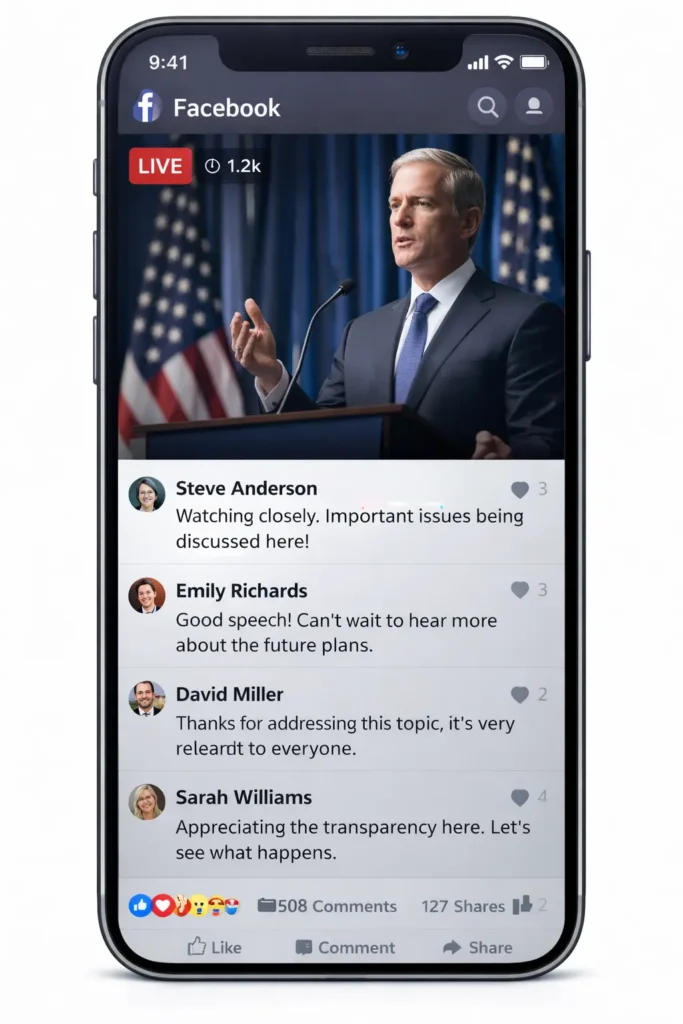
Regular Q&A sessions create consistent opportunities for direct interaction.
Planning Effective Q&A Sessions
Choose consistent timing. “Every first Thursday of the month at 7 PM” is better than random scheduling. Consistency builds habit.
Announce well in advance. Post about upcoming Q&A sessions days ahead. Remind people the day before and hour before.
Collect questions ahead of time. Ask people to submit questions in advance. This ensures you address real concerns and helps you prepare thoughtful answers.
Select diverse topics. Don’t only discuss your favorite issues. Address what constituents actually care about.
Set clear format. Explain how the session works:
- Duration (typically 30-60 minutes)
- How to submit questions (comments, messages, specific post)
- Whether all questions will be addressed or you’ll select some
- Whether it’s live video or written responses
During Q&A Sessions
Start on time. Respect people who showed up when announced.
Restate questions before answering. Not everyone sees the original question. Restating provides context for all viewers.
Be honest about what you don’t know. “I don’t know the answer, but I’ll find out and post an update by Friday” is better than guessing or being vague.
Balance depth and breadth. Answer some questions thoroughly, others more briefly so you can cover more topics.
Acknowledge questioners by name. “Great question, Sakib. Here’s my view…” Personal acknowledgment encourages more participation.
Handle difficult questions gracefully. You’ll get challenging or hostile questions. Address them professionally without getting defensive.
Watch time. Let people know when you’re approaching the end. “Ten minutes left, I’ll take a few more questions.”
Summarize at the end. Briefly recap the main topics discussed.
After Q&A Sessions
Post summary. For people who missed the live session, post a summary of questions discussed and key points from your answers.
Follow up on promises. If you said you’d look into something, actually do it and post updates.
Thank participants. Acknowledge everyone who submitted questions or attended.
Analyze what worked. Which questions generated most discussion? What topics interested people most? Use this to plan future content and sessions.
Building Supporter Networks
Community includes active supporters who amplify your message and defend your reputation.
Identifying Potential Advocates
Active engagers. People who frequently comment, share your posts, and participate in discussions.
Issue advocates. Community members passionate about specific causes you champion.
Local influencers. Respected community members with their own networks.
Event attendees. People who show up to physical events demonstrate higher commitment.
Volunteers. Those who’ve helped with campaigns or community service.
These people are your community’s core. Invest extra attention in these relationships.
Nurturing Advocate Relationships
Acknowledge them publicly. When supporters consistently engage or help, thank them publicly (with permission).
Give them inside access. Share preview content, ask their input on ideas, give them early information about announcements.
Facilitate supporter connections. Help supporters connect with each other, not just with you. Strong supporter networks sustain themselves.
Provide shareable content. Create graphics, videos, and posts that supporters can easily share with their networks.
Ask for their help explicitly. “I need help spreading the word about this initiative. If you believe in this, please share.” Direct requests work better than hoping people will share.
Recognize different contribution styles. Some people share content. Others comment frequently. Some organize offline. Value all forms of support.
Creating Supporter Programs
Formalize supporter networks. Consider creating:
Digital volunteer corps: Trained supporters who help with online engagement, content sharing, and reputation defense.
Issue ambassadors: Advocates focused on specific causes (education, healthcare, environment) who engage on those topics.
Community representatives: Trusted members from different areas or demographics who provide feedback and help communicate with their specific communities.
Benefits of formal programs:
- Clarity about roles and expectations
- Organized communication channels
- Systematic training and updates
- Recognition and appreciation systems
Keep barriers low. Don’t make it so formal that people feel intimidated to participate. Balance structure with accessibility.
Handling Trolls and Negative Commenters
Every political leader faces negative comments and trolling. How you handle them affects community dynamics.
Distinguishing Trolls from Critics
Trolls:
- Make personal attacks without substance
- Use abusive or inflammatory language
- Don’t engage with reasoned responses
- Goal is provocation, not discussion
- Often new or fake accounts
Strategy: Ignore, delete if abusive, or ban repeat offenders
Legitimate Critics:
- Disagree with your positions substantively
- Raise genuine policy concerns
- May be frustrated but not abusive
- Open to reasoned discussion
- Often established, real accounts
Strategy: Engage respectfully and professionally
Treating everyone as trolls alienates legitimate critics. Treating trolls as legitimate critics wastes time and energy.
Response Strategies
For trolls:
Option 1 – Ignore completely. Often best. Trolls want attention. Denying it usually makes them move on.
Option 2 – Delete if clearly abusive. Comments with profanity, threats, or harassment should be removed.
Option 3 – Ban repeat offenders. Facebook allows banning users from your page. Use this for persistent trolls.
What not to do: Don’t engage in arguments with trolls. You can’t win and it makes you look unprofessional.
For legitimate critics:
Acknowledge the concern. “I understand you’re frustrated about [issue].”
Explain your position. Clearly and without being condescending.
Find common ground if possible. “We both want [shared goal], we just disagree on the best approach.”
Offer to continue offline if needed. “This deserves more detailed discussion than comments allow. Would you like to schedule a call or meeting?”
Thank them for engaging. Even critics who engage respectfully deserve thanks for participating in dialogue.
Setting Comment Policies
Establish clear community guidelines. Post these prominently:
“Community Guidelines for this page:
- Respectful dialogue is welcome
- Disagree with ideas, not with personal attacks
- No profanity or hate speech
- No spam or commercial promotion
- Stay on topic
Comments violating these guidelines will be removed. Repeat offenders will be banned.”
Clear rules make moderation decisions easier and more defensible.
Apply rules consistently. Don’t delete criticism just because it’s unflatable. Only delete comments that actually violate stated guidelines.
Explain removals when necessary. If you delete a comment, briefly explain why. “Comment removed for violating community guidelines against personal attacks.”
Measuring Community Engagement Quality
Not all engagement is equally valuable. Focus on metrics that indicate genuine community building.
Key Engagement Metrics
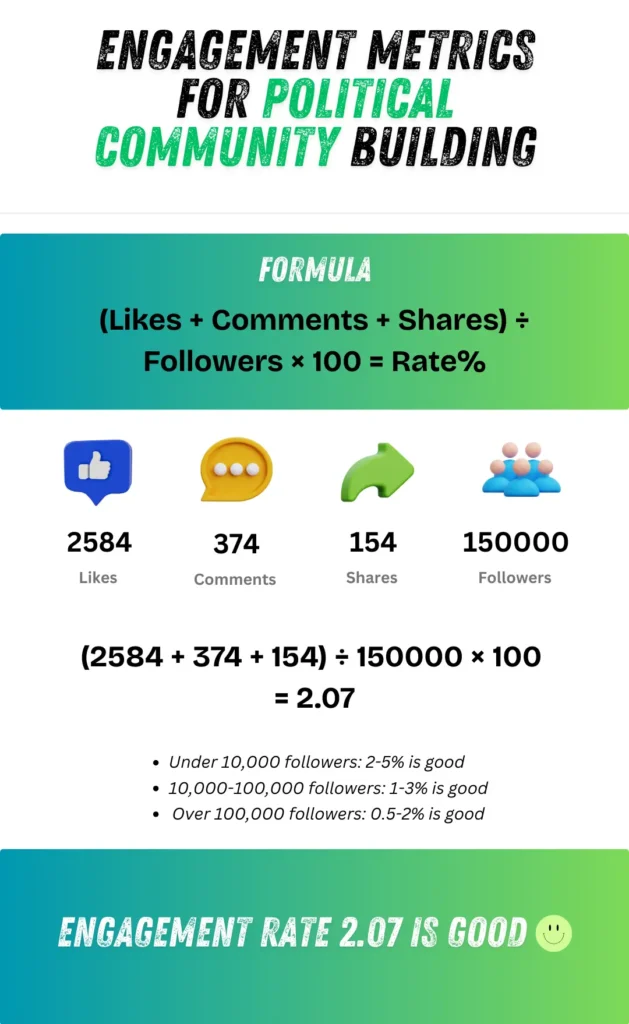
Engagement rate: (Likes + Comments + Shares) ÷ Followers × 100
Healthy engagement rates vary by follower count:
- Under 10,000 followers: 2-5% is good
- 10,000-100,000 followers: 1-3% is good
- Over 100,000 followers: 0.5-2% is good
Comment quality: Are comments substantive or just emoji reactions? Deep comments indicate stronger community.
Share rate: Shares spread content beyond your existing audience. High share rates indicate valuable content.
Response rate: What percentage of comments get replies from you or your team? Aim for 50%+.
Return engagement: Do the same people engage repeatedly or is it always different people? Repeat engagers indicate community loyalty.
Offline action: Do engaged followers attend events, volunteer, or take action offline? Online engagement that doesn’t translate offline is shallow.
Analytics Tools
Facebook Insights: Shows engagement metrics, best performing posts, when audience is active, and demographic information.
Messenger statistics: Track response time, response rate, and conversation volume.
Manual tracking: For some metrics (comment quality, sentiment), you need human review. Sample 20-30 comments weekly to assess quality.
Using Data to Improve
Double down on what works. If educational posts get high engagement, create more educational content.
Experiment with timing. Test posting at different times to find optimal engagement windows for your specific audience.
Learn from top posts. Your highest-engagement posts reveal what your community values. Analyze patterns.
Address engagement drops. If engagement declines, diagnose why:
- Posting less frequently?
- Content less relevant?
- Not responding to comments?
- Algorithm changes?
Identify and address the cause.
Converting Followers into Voters and Volunteers
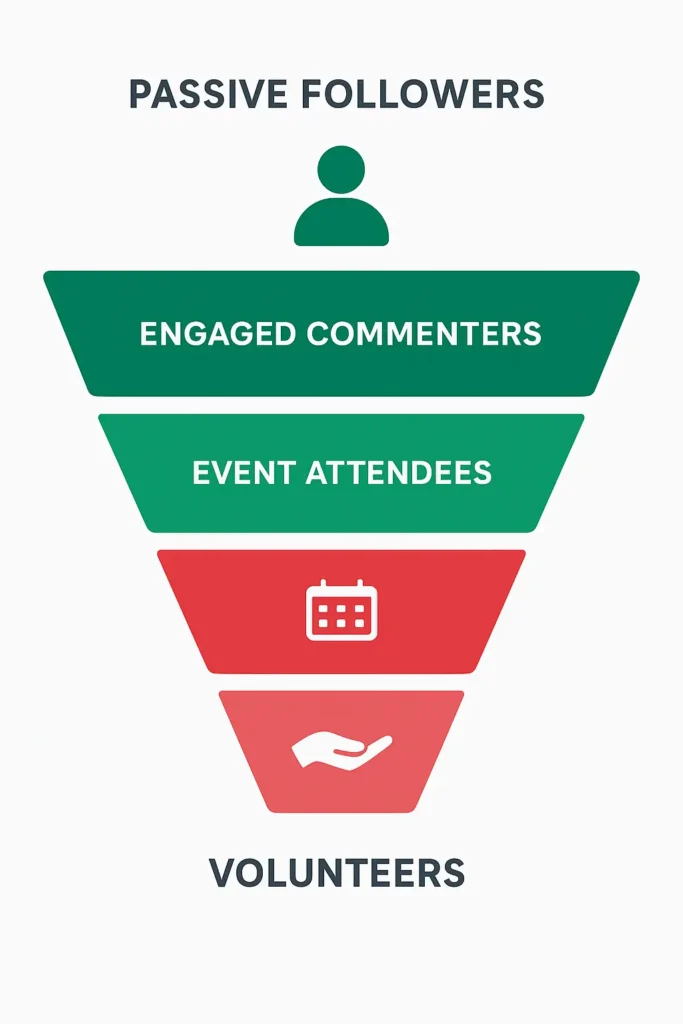
Community engagement should ultimately support your political goals.
Moving from Digital to Physical Engagement
Event announcements: Use online community to drive physical event attendance.
Volunteer recruitment: Engaged online supporters are prime volunteer candidates. Make asks directly: “We need volunteers for [activity]. Who can help?”
Voter registration drives: Use digital engagement to promote registration and voting.
Petition signing: When working on specific issues, mobilize your online community to sign petitions or submit public comments.
Meeting attendance: Invite community members to town halls, listening sessions, or policy discussions.
The ask strategy:
Start with small asks (share a post, answer a poll) before bigger asks (volunteer, donate, organize). People who say yes to small commitments are more likely to say yes to larger ones later.
Building a Mobilization System
Segment your community:
- Highly engaged (comment and share frequently)
- Moderately engaged (like posts, occasional comments)
- Passive (follow but rarely engage)
Target asks appropriately:
- Highly engaged: Big asks (volunteer, organize, lead)
- Moderately engaged: Medium asks (attend events, share content)
- Passive: Small asks (sign petition, answer poll)
Create clear pathways:
“Interested in helping with education reform? Here’s how:
- Share our education posts to spread awareness
- Attend our education town hall next month
- Join our education policy volunteer group
- Help organize community education events”
Clear steps make participation easier.
Follow up and appreciate:
When someone takes action, acknowledge it. People who feel appreciated continue participating.
“Thank you to the 50 community members who attended our town hall last night. Your input is shaping our education initiative. Follow-up notes will be posted by Friday.”
Long-Term Community Maintenance
Building community is ongoing work, not a one-time project.
Consistency Over Time
Maintain presence year-round. Community withers if you only show up during elections.
Continue engagement during non-election periods. The relationships built between elections sustain you during campaigns.
Celebrate community milestones. When your online community reaches follower milestones or achieves something together, acknowledge it.
Evolving with Your Community
Communities change. As new people join and priorities shift, adapt your engagement strategies.
Regular feedback collection. Periodically ask what your community wants:
- What topics interest you most?
- What kinds of posts are most valuable?
- How can I serve you better?
Adjust based on responses. Actually use the feedback you collect to improve.
Preventing Community Fatigue
Don’t over-ask. Constantly asking for shares, attendance, or support exhausts people. Balance asks with giving value.
Vary content types. Mix educational, inspirational, behind-the-scenes, and call-to-action content.
Recognize burnout. If engagement drops across the board, your community might be fatigued. Pull back on asks and focus on value provision for a while.
Building an engaged digital community is one component of comprehensive online reputation management. Successful community engagement works in concert with professional website presence, authentic content creation, crisis management protocols, and strategic reputation monitoring. For the complete framework on managing all aspects of your political digital presence, see our guide on online reputation management for Bangladeshi politicians.
Common Community Building Mistakes
After managing community engagement for years, I’ve seen these mistakes damage community building efforts.
Talking without listening. Broadcasting messages without genuinely listening to community feedback creates one-way communication, not community.
Inconsistent engagement. Engaging heavily one month then disappearing the next confuses and disappoints community members.
Only engaging when you need something. Appearing only to ask for votes, donations, or support makes you look opportunistic.
Deleting all criticism. Removing every negative comment makes you seem afraid of feedback and damages trust.
Ignoring your most engaged supporters. Taking your biggest supporters for granted causes them to disengage.
Treating online community as separate from offline. Your digital and physical communities should reinforce each other, not exist in isolation.
Using manipulation tactics. Fake engagement tactics (buying likes, using clickbait, emotional manipulation) might boost numbers but destroy genuine community trust.
Failing to set boundaries. Without clear guidelines, communities can become toxic or derail from their purpose.
Not empowering community leaders. Trying to personally manage every interaction doesn’t scale. Identify and empower community leaders who can help.
Measuring only vanity metrics. Focusing on follower count rather than genuine engagement misses what actually matters.
Creating Your Community Engagement System
Sustainable community building requires systems and dedicated resources.
Assign specific responsibilities:
- Who monitors comments daily?
- Who responds to messages?
- Who moderates discussions?
- Who plans engagement activities?
- Who measures and reports on community health?
Create response templates: For common questions and scenarios, develop response templates your team can customize. This ensures consistency and saves time.
Establish escalation protocols: When should routine issues be escalated to you personally? Create clear criteria so team members know when to involve you.
Schedule regular community activities:
- Weekly: Engagement post (question, poll, or discussion prompt)
- Bi-weekly: Live Q&A or town hall
- Monthly: Community recognition and appreciation
- Quarterly: Major community event or initiative
Review and adjust quarterly: Every three months, assess:
- Which engagement tactics work best?
- Where are we falling short?
- What does the community feedback tell us?
- How can we improve?
Systems prevent community building from being dependent on inspiration or memory.
Final Thoughts
Building genuine digital community in Bangladesh takes time, consistency, and authentic commitment to serving constituents.
With 73.39 million Bangladeshis on Facebook, 56.2 million on TikTok, and 68.6 million using Messenger, the platforms for community building are mature and widely accessible. But platforms are just tools. Community is built through genuine human connection, consistent engagement, and demonstrated care for the people you serve.
The political leaders who thrive in Bangladesh’s digital future won’t be those with the most followers. They’ll be those with the most engaged, loyal communities who actively support, defend, and amplify their work.
Your community becomes your most valuable political asset. They vote reliably. They convince others. They volunteer during campaigns. They defend you during controversies. They provide feedback that makes you better. They sustain your political work between elections.
But community isn’t built through manipulation or tactics alone. It grows from genuine respect for constituents, consistent accessibility, honest communication, and demonstrated follow-through on commitments.
Start building today. Respond to comments. Answer messages. Hold Q&A sessions. Acknowledge supporters. Help solve problems. Show up consistently. Follow through on promises.
Over months and years, these small actions compound into genuine community. That community becomes the foundation of sustainable political success.
Need help building and managing engaged digital communities? We help with response systems, engagement planning, supporter programs, and community management.