Google AI Overviews are not a future trend. They are already reshaping how millions of people find information right now. If your website is not optimized to appear in them, you are invisible to a growing portion of your target audience.
Here is what you need to know, and exactly what to do about it.
What Is a Google AI Overview?
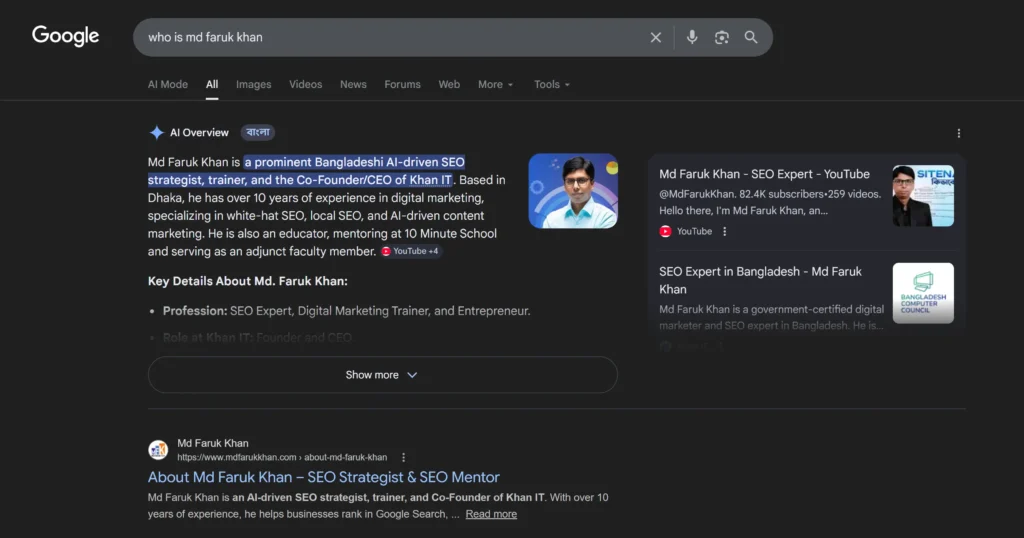
A Google AI Overview is an AI-generated summary that appears at the very top of search results, above the organic blue links. Google pulls information from multiple trusted sources, synthesizes it, and presents a direct answer to the user’s query.
These overviews are powered by Gemini 2.0. They analyze context and perspectives across multiple pages, then deliver a synthesized answer.
The key thing to understand: Google is not just copying one page. It is reading dozens of sources and building an answer. Your goal is to be one of those sources it trusts enough to cite.
As of late 2025, AI Overviews appear on roughly 16% of all queries, down from a peak of nearly 25% mid-year as Google adjusted the feature based on user behavior data. The coverage is still significant, and it is growing in commercial niches.
Why This Changes Everything for Your SEO Strategy
For ten years, the goal was simple: rank in the top three positions and get clicks. AI Overviews change that game in two important ways.
First, your page can now get cited in an AI Overview even if it does not rank in the top ten. Only 33.4% of AI Overview links appear in the top 10 organic results for any given query. That means a page sitting at position 15 or 20 can still drive traffic if it is the clearest, most direct answer to the question.
Second, the traffic you do get from AI Overviews is more valuable. When people click to a website from a search results page with an AI Overview, those clicks are higher quality, with users more likely to spend more time on the site. Google They arrive more informed, more qualified, and closer to a decision.
I have seen this pattern consistently across my client work. The businesses that get cited in AI Overviews see smaller traffic numbers but far higher conversion rates. Quality beats quantity here.
What Types of Searches Trigger AI Overviews?
Before you optimize a single page, you need to understand which searches actually trigger an AI Overview. Not every query gets one.
Question-based searches represent the highest opportunity for AI Overview inclusion. Queries phrased as questions or how-to’s are now 84% more likely to display an AI Overview.
Advanced Web Ranking research found that searches triggering AI Overviews usually contain around five words and use terms like “how,” “tips,” “practices,” and “best.”
Practically speaking, this means you should be targeting queries like:
- “How do I improve my Shopify store’s SEO?”
- “What is the best way to do local SEO for a service business?”
- “Why is my SMM panel not ranking on Google?“
These are the exact types of questions your potential clients are typing. Structure your content around answering them directly.
The Seven Things That Actually Get You Cited in AI Overviews
1. Answer the Question in the First 100 Words
Google’s AI does not want to dig through three paragraphs of background before it finds your actual answer. Neither does your reader.
Lead with answers. Start sections with a direct definition or takeaway before adding more context.
This is something I apply to every service page and blog post I build for clients. The Pet Zone BD project, where we achieved 1,454% organic traffic growth, started with a full content restructure that put direct answers at the top of every category page. Rankings followed within weeks.
Write your answer first. Explain it second.
2. Build Real Topical Authority
One blog post on a topic is not enough. Google’s AI looks for websites that cover a subject in depth across multiple interconnected pages.
Sites that cover a subject in depth, not just at a surface level, tend to be favored because they show Google the publisher is a true authority.
For mdfarukkhan.com, this means every page on AI SEO, GEO, and entity-based SEO should link to each other and point back to a central pillar page. The internal linking structure is not optional. It is what tells Google that you own this topic space.
If you are publishing isolated blog posts with no internal links between them, you are building sand castles. Build a network instead.
3. Format Content So AI Can Parse It Easily
AI systems read your content differently from humans. They look for structure, clear definitions, and patterns that signal a direct answer.
Use structured formatting. Bullet points, numbered lists, and FAQs work well with how AI models summarize content.
Every service page I build follows a strict structure: problem statement, explanation, evidence, FAQ section. That FAQ section at the bottom is not just for user experience. It creates structured question-and-answer pairs that AI systems can extract and cite directly.
Use H2 and H3 headings that mirror real questions. Write FAQ sections with natural conversational language. Define your key terms clearly and early.
4. Demonstrate EEAT With Evidence, Not Just Claims
This is where most websites fail. They claim expertise. They do not prove it.
Adding content that demonstrates real-world expertise will strengthen the chances of being included in the AI Overview. Show how strategies play out in real business settings through case studies, and share first-hand experiences with original insights or data that competitors cannot replicate.
When I worked with a London property compliance company, we took them from approximately 154 monthly visitors to 721 monthly clicks and 107,000 monthly impressions in 12 months. That result is documented, verifiable, and specific. It is the kind of evidence that builds both human trust and AI trust signals.
Vague claims like “I have years of experience in SEO” do nothing. Specific, verifiable outcomes do everything.
5. Keep Your Content Fresh
Outdated or stagnant pages are less likely to be surfaced by Google’s AI.
AI Overviews prioritize content that reflects the current state of a topic. In a field like SEO that changes every few months, a blog post from 2022 that has never been updated is a liability, not an asset.
Build a content calendar that includes update cycles, not just new publish dates. Every major page on your site should be reviewed and refreshed at least once per year. Add new data, update statistics, and reflect recent algorithm changes.
6. Fix the Technical Foundation First
None of the content work above matters if Google cannot properly crawl and understand your site.
The best practices for SEO remain fully relevant for AI features in Google Search. There are no additional special requirements to appear in AI Overviews beyond solid SEO fundamentals. Make sure your pages are crawlable, indexable, and technically sound.
Pages that load in one to two seconds see lower bounce rates, and mobile optimization matters more with Google’s mobile-first indexing.
Before you rewrite a single word of content, run a full technical audit. Check crawlability, fix broken internal links, compress images, and verify your Core Web Vitals in Google Search Console. A slow, crawl-blocked site will not appear in AI Overviews no matter how good your content is.
7. Use Schema Markup Strategically
FAQ schema mirrors voice and conversational follow-ups. How-to schema works well for procedures. Use schema markup when the content genuinely fits the pattern, and avoid over-marking unrelated sections.
For every service page, I recommend implementing at minimum: FAQ schema, Person schema on author pages, and Service schema on service pages. These do not guarantee AI Overview inclusion, but they make it significantly easier for Google’s systems to understand what your page is about and who wrote it.
A Common Mistake That Kills Your Chances
Burying your answer.
If the first answer to a query appears halfway down the page, AI models may favor a clearer source instead.
I see this on nearly every site I audit. The writer spends 400 words on background, history, and context before finally answering the question the user actually asked. Google’s AI has already moved on to a cleaner source by that point.
Your first paragraph should answer the question. Everything after it should support and expand that answer.
How to Find Your Best Opportunities Right Now
You do not need to start from scratch. Your best AI Overview opportunities are already on your website.
Open Google Search Console and look for pages with strong impressions but lower-than-expected click-through rates. These pages are already visible to Google, but users are not clicking because they are getting their answer from an AI Overview that is citing someone else.
Those pages are your priority targets. Restructure them using the principles above: lead with a direct answer, add an FAQ section, tighten your formatting, and update any outdated statistics.
Pages in the top 10 organic results appear in AI Overviews 60% of the time. But AI Overviews also feature pages outside the top 10 about 40% of the time. That second number is your opportunity.
What Google Says About AI Overview Optimization
It is worth being direct about what Google itself has stated.
According to Google’s official Search Central documentation, there are no special additional requirements to appear in AI Overviews beyond standard SEO best practices. You do not need to create new machine-readable files, AI text files, or special markup.
This means consultants or agencies telling you they have a secret formula to guarantee AI Overview placement are not being truthful. What actually works is the same thing that has always worked in SEO: genuinely useful, well-structured, authoritative content.
The difference now is that “well-structured” has a more precise meaning, and “authoritative” requires more documented evidence than it used to.
The Bigger Picture: AI Overviews Are One Part of a Larger Shift
AI Overviews are one piece of a broader change in how search works. Alongside them, platforms like ChatGPT, Perplexity, and Google’s own AI Mode are all pulling from the web to answer questions directly.
This is what I call Generative Engine Optimization (GEO): the practice of structuring your content so it gets cited not just in traditional search results, but across all AI-powered platforms.
The websites that will win over the next three years are the ones being built right now with this in mind. Clear answers, real evidence, defined entities, and strong internal topic clusters.
If you are still optimizing only for keyword density and backlinks, you are already behind.
FAQs
What is a Google AI Overview?
A Google AI Overview is an AI-generated summary that appears at the top of search results. Google pulls information from multiple trusted web sources, synthesizes it, and presents a direct answer to the user’s question without them needing to click a link.
Do I need to be in the top 10 to appear in Google AI Overviews?
No. Research shows that roughly 40% of pages cited in AI Overviews do not rank in the top 10 organic results for that query. What matters more than your ranking position is how clearly and directly your content answers the specific question being asked.
Does Google use schema markup to select AI Overview sources?
Schema markup helps Google understand your content better, and FAQ schema in particular creates structured question-and-answer patterns that AI systems can parse easily. While a schema is not a guarantee of AI Overview inclusion, it makes your content significantly easier for Google to use.
Can I appear in AI Overviews even if my domain is relatively new?
Yes, but it is harder. AI Overviews favor authoritative sources, and domain authority takes time to build. Your fastest path is to create extremely specific, direct content on narrow questions where established sites have not published a clear answer yet.
What types of content appear most often in AI Overviews?
Question-based and how-to content triggers AI Overviews most frequently. Informational queries with five or more words, especially those using terms like “how,” “what,” “best,” or “tips,” are the most reliable triggers. Commercial queries trigger AI Overviews far less often than informational ones.
Will appearing in an AI Overview reduce my website clicks?
Not necessarily. Google’s own data shows that clicks from pages with AI Overviews are higher quality, with users spending more time on the site after clicking. The volume may be lower, but the intent is stronger.