

Voice search SEO is how you optimize your website so people can find your business when they ask questions to Google Assistant, Alexa, or Siri instead of typing. If you’re running a business in Bangladesh and wondering “what is voice search SEO,” you’re asking the right question at the right time.
Let me explain it in the simplest way possible.
Think about how you use your phone. When you’re driving or cooking and need to find something quickly, you probably say “Hey Google, where can I buy fresh vegetables near me?” instead of stopping to type. That’s voice search.
More and more people in Bangladesh are using voice search every day. Whether they’re asking Google Assistant in Bangla or English, looking for restaurants in Dhaka, or finding the nearest pharmacy, voice search is changing how customers discover businesses.
This is exactly why voice search optimization matters for your business in 2026.
Table of Contents
- Understanding Voice Search: What Does It Actually Mean?
- How Voice Search Actually Works
- Voice Search Growth in Bangladesh
- Text Search vs Voice Search: What’s the Difference?
- Real Voice Search Examples from Bangladesh
- Why Voice Search SEO Matters for Your Business
- How to Optimize Your Website for Voice Search in Bangladesh
- Step 1: Write Like People Talk
- Step 2: Answer Questions Directly
- Step 3: Use Question-Based Headings
- Step 4: Create FAQ Sections
- Step 5: Optimize for Local Searches
- Step 6: Focus on Long-Tail Keywords
- Step 7: Improve Page Speed
- Step 8: Use Structured Data
- Step 9: Create Location-Specific Content
- Step 10: Keep Content Simple and Clear
- Common Voice Search SEO Mistakes to Avoid
- Voice Search and Featured Snippets
- Voice Search Tools and Resources
- The Future of Voice Search in Bangladesh
- Voice Search for Different Business Types
- Measuring Voice Search Success
- Getting Started Today
Understanding Voice Search: What Does It Actually Mean?
Voice search means using your voice instead of typing to search for information on the internet. Instead of opening Google and typing “best biryani restaurant Dhaka,” you simply say “Hey Google, find me the best biryani restaurant near me.”
The device listens, understands your question, and gives you answers. Sometimes it reads results out loud. Other times, it shows you a list on your screen.
Let me give you a real example from Bangladesh.
Imagine someone in Dhanmondi needs an electrician urgently. Ten years ago, they would have:
- Opened their laptop or phone
- Typed “electrician Dhanmondi Dhaka”
- Scrolled through results
- Called multiple numbers
Today, they simply say: “Ok Google, find an electrician near me who’s available now.”
Google understands their location (Dhanmondi), their need (electrician), and their urgency (available now). It shows local electricians with phone numbers, ratings, and directions.
This convenience is why voice search is growing so fast, especially in cities like Dhaka, Chittagong, and Sylhet.
How Voice Search Actually Works
Voice search technology uses artificial intelligence to understand natural human speech. Here’s what happens in just a few seconds:
Step 1: You Speak You activate voice search by saying “Hey Google,” “Alexa,” or “Hey Siri” and then ask your question naturally.
Step 2: Device Listens Your phone or smart speaker records your voice and converts it into text using speech recognition technology.
Step 3: AI Understands Google’s AI (specifically BERT and similar systems) understands the meaning and context behind your words, not just individual keywords.
Step 4: Search Happens The system searches for the best answer based on your location, search history, and the question’s intent.
Step 5: You Get Results The device either reads the answer out loud or displays relevant results on your screen.
This entire process happens so fast that it feels instant. But behind the scenes, complex technology is working to understand exactly what you need.
Voice Search Growth in Bangladesh
Voice search is growing rapidly in Bangladesh for several clear reasons.
Smartphone Penetration Bangladesh now has over 100 million smartphone users. Most modern Android phones come with Google Assistant built in. This means millions of people already have voice search capability in their pockets.
Bangla Language Support Google Assistant now understands Bangla very well. People can ask questions in their native language and get accurate results. This removes the language barrier that prevented many people from using search effectively.
Internet Speed Improvements With 4G networks widely available in cities and even many rural areas, voice search works smoothly and quickly. Better internet means better voice recognition accuracy.
Busy Urban Lifestyle In Dhaka’s traffic or while multitasking at home, people prefer speaking to typing. Voice search saves time and effort, making it perfect for Bangladesh’s fast-paced urban lifestyle.
Lower Literacy Requirements Not everyone types comfortably in English or even Bangla. Voice search allows people who struggle with typing to access information easily. This democratizes internet access.
According to recent data, voice searches in Bangladesh have grown by over 150% in the past two years. This trend will continue as more people discover how convenient it is.
Text Search vs Voice Search: What’s the Difference?
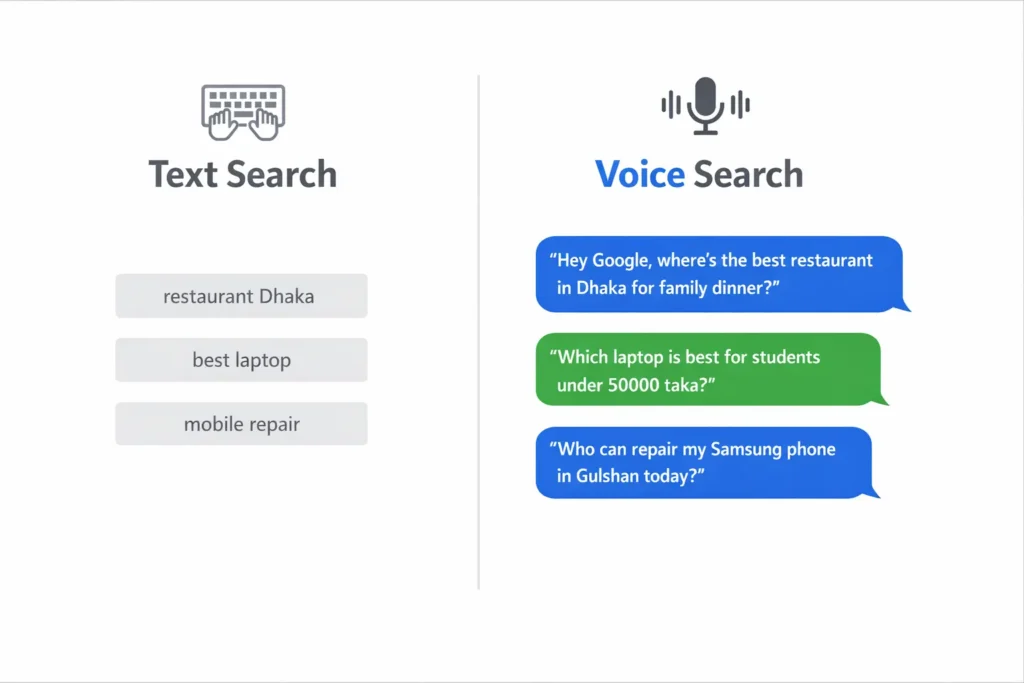
Understanding the difference between how people type and how people speak is crucial for voice search optimization.
Text Search (Traditional):
When someone types, they use short, broken phrases.
Examples:
- “best restaurant Gulshan”
- “mobile repair Dhaka”
- “lawyer Bangladesh”
These are keyword-focused, not natural language.
Voice Search (Natural Language):
When someone speaks, they use complete, natural sentences and questions.
Examples:
- “Hey Google, what’s the best restaurant in Gulshan for family dinner?”
- “Where can I get my iPhone repaired in Dhaka?”
- “Find me a property lawyer in Bangladesh who speaks English”
Notice the difference? Voice searches are:
- Longer and more detailed
- Question-based (who, what, where, when, why, how)
- Conversational and natural
- Often include location indicators
- More specific about intent
This difference completely changes how you need to optimize your website content.
Real Voice Search Examples from Bangladesh
Let me show you practical examples you can relate to.
Example 1: Restaurant Discovery
Text search: “Chinese restaurant Banani”
Voice search: “Ok Google, show me Chinese restaurants in Banani that are open right now with delivery option”
Why the voice search is different:
- Specifies current availability (“open right now”)
- Mentions delivery preference
- More detailed requirements
- Natural speaking pattern
If you own a restaurant in Banani, your website needs content that answers these complete questions, not just lists “Chinese restaurant Banani” repeatedly.
Example 2: Medical Services
Text search: “dentist Dhanmondi”
Voice search: “Hey Google, find a dentist in Dhanmondi who accepts walk-in patients today”
Why this matters:
- Includes urgency factor (“today”)
- Specifies appointment type (“walk-in”)
- Complete question format
- Location-specific
Your medical practice website should include information about walk-in availability, emergency services, and location details in natural language.
Example 3: Shopping Queries
Text search: “laptop price Bangladesh”
Voice search: “What’s the price of Dell Inspiron 15 laptop in Bangladesh with warranty?”
Why voice is more specific:
- Brand and model mentioned (Dell Inspiron 15)
- Additional requirement (warranty)
- Complete question structure
- Looking for specific information
E-commerce sites need detailed product pages with complete specifications, pricing, and warranty information written conversationally.
Example 4: Local Services
Text search: “AC repair Uttara”
Voice search: “Who can repair my split AC in Uttara sector 7 within 2 hours?”
Why this is valuable:
- Specific service type (split AC)
- Precise location (sector 7)
- Time expectation (within 2 hours)
- Urgent intent
Service businesses should include response time information, coverage areas, and service types clearly on their websites.
Why Voice Search SEO Matters for Your Business
You might wonder, “Why should I care about this?”
Here are the real benefits for businesses in Bangladesh:
1. Customers Find You Faster
When someone needs your service urgently and uses voice search, you want to appear in results. Voice search often shows fewer options (typically 3-5 results) compared to text search (10+ results per page). If you optimize correctly, you have a better chance of being one of the top choices.
2. Growing Mobile Usage
Most voice searches happen on mobile phones. Bangladesh is a mobile-first country. Optimizing for voice search means optimizing for how most Bangladeshis actually use the internet.
3. Local Business Advantage
Voice searches often include “near me” or specific location mentions. If you run a local business in Dhaka, Chittagong, or Sylhet, voice search helps nearby customers discover you instantly.
4. Less Competition Right Now
Many businesses in Bangladesh haven’t optimized for voice search yet. If you start now, you’ll have a competitive advantage before others catch up.
5. Better Customer Experience
When you optimize for voice search, you naturally create better, more helpful content. You answer questions clearly, provide complete information, and make your site easier to use. This benefits all visitors, not just voice searchers.
6. Future-Proof Your Business
Voice search will only grow. Smart speakers, car systems, and home assistants are becoming more common. Preparing now means your business stays relevant as technology evolves.
Just like how I helped businesses succeed with semantic SEO strategies, voice search optimization is about understanding how people naturally communicate and meeting them where they are.
How to Optimize Your Website for Voice Search in Bangladesh
You don’t need technical expertise to start optimizing for voice search. Here are simple, practical steps:
Step 1: Write Like People Talk
Stop writing in stiff, formal business language. Write like you’re having a conversation with a customer.
Instead of: “Our establishment provides automobile maintenance services.”
Write: “We repair and service all types of cars at our garage in Mohammadpur. We can fix engine problems, change oil, replace brake pads, and handle air conditioning issues.”
This natural, conversational style matches how people ask voice questions.
Step 2: Answer Questions Directly
Create content that answers common customer questions. Think about what people actually ask about your business.
For a clothing store, create content answering:
- “What are the opening hours of your store?”
- “Do you offer cash on delivery?”
- “What sizes do you have available?”
- “Where is your showroom located?”
- “Can I return items if they don’t fit?”
Put these questions as actual headings (H2 or H3) on your website and answer them clearly underneath.
Step 3: Use Question-Based Headings
Voice searches are questions. Your headings should reflect this.
Good headings for voice search:
- “How much does website design cost in Bangladesh?”
- “Where can I find fresh organic vegetables in Dhaka?”
- “What documents do I need to open a bank account?”
- “Who provides 24-hour plumbing service in Chittagong?”
When Google sees these question headings with clear answers, it can feature your content in voice search results.
Step 4: Create FAQ Sections
Every service page and product page should have a Frequently Asked Questions section. List real questions customers ask and provide clear, complete answers.
Example for a travel agency:
- Q: How much does a Cox’s Bazar tour package cost?
- A: Our Cox’s Bazar 3-day, 2-night package costs 12,000 taka per person, including hotel, meals, and transport from Dhaka.
These FAQ sections are perfect for voice search because they match exactly how people ask questions.
Step 5: Optimize for Local Searches
Most voice searches have local intent. Make sure your website clearly states:
- Your exact location with area name and landmarks
- Cities and neighborhoods you serve
- Contact phone number prominently displayed
- Business hours clearly listed
- Directions and how to reach you
Claim and optimize your Google Business Profile. This is critical for appearing in “near me” voice searches. Update your business information, add photos, collect reviews, and keep hours accurate.
Step 6: Focus on Long-Tail Keywords
Long-tail keywords are longer, more specific phrases. Voice searches use these naturally.
Instead of targeting: “restaurant Dhaka”
Target: “family-friendly restaurant in Dhanmondi with vegetarian options”
Create content around these longer, more specific phrases that match how people actually speak.
Step 7: Improve Page Speed
Voice search users want quick answers. If your website loads slowly, you’ll lose potential customers.
Test your site speed using free tools and make improvements:
- Compress images
- Use faster hosting
- Minimize unnecessary plugins
- Enable caching
Mobile page speed is especially important since most voice searches happen on phones.
Step 8: Use Structured Data
Structured data (also called schema markup) helps Google understand your content better. While this sounds technical, WordPress plugins like Rank Math or Yoast SEO can add it easily.
For a local business, add:
- Business name
- Address
- Phone number
- Opening hours
- Services offered
- Customer reviews
This structured information helps your business appear in voice search results with complete, accurate details.
Step 9: Create Location-Specific Content
If you serve multiple areas, create separate pages or sections for each location.
For a delivery restaurant:
- “Food Delivery in Gulshan”
- “Food Delivery in Banani”
- “Food Delivery in Uttara”
Each page should mention the specific area, landmarks, delivery times, and any area-specific offers.
Step 10: Keep Content Simple and Clear
Voice search answers are usually short and direct. Google often reads a brief snippet out loud.
Aim for:
- Short paragraphs (2-3 sentences)
- Simple language (avoid jargon)
- Clear, direct answers
- Scannable formatting
If someone asks “What are your business hours?” and your website has a clear sentence saying “We are open Monday to Saturday from 9 AM to 8 PM,” Google can easily use that as a voice search answer.
Common Voice Search SEO Mistakes to Avoid
Based on my experience helping businesses with SEO, here are mistakes I see often:
Mistake 1: Ignoring Bangla Content
Many businesses only create English content. But a huge number of voice searches in Bangladesh happen in Bangla. Consider adding Bangla content or at least Bangla keywords for common questions.
Mistake 2: Not Claiming Google Business Profile
If you haven’t claimed and optimized your Google Business Profile, you’re invisible to local voice searches. This is the single biggest mistake local businesses make.
Mistake 3: Using Only Short Keywords
Focusing only on short keywords like “lawyer Dhaka” doesn’t help with voice search. You need longer, question-based content.
Mistake 4: Complicated Website Structure
If customers can’t find information easily on your site, neither can Google’s voice search. Keep navigation simple and information accessible.
Mistake 5: No Mobile Optimization
If your website doesn’t work well on mobile phones, you’ve already lost voice search traffic. Most voice searches happen on mobile devices.
Mistake 6: Missing Contact Information
Voice search users often want to contact you immediately. If your phone number isn’t prominent and clickable on mobile, you’re losing calls.
Mistake 7: Ignoring Reviews
Customer reviews influence voice search rankings. Businesses with more positive reviews appear more often in voice search results. Actively collect reviews from happy customers.
Voice Search and Featured Snippets
Featured snippets are the short answer boxes that appear at the top of Google search results. When someone uses voice search, Google often reads the featured snippet as the answer.
Getting your content into featured snippets dramatically increases voice search visibility.
How to optimize for featured snippets:
1. Answer Questions Concisely Provide clear, direct answers in 40-60 words right after the question heading.
2. Use Lists and Steps When explaining processes, use numbered lists or bullet points. Google loves featuring these.
Example: “How to open a bank account in Bangladesh:
- Visit the bank with your national ID card
- Fill out the account opening form
- Submit one passport-size photo
- Make the minimum deposit (usually 500-1000 taka)
- Receive your account number and debit card within 7 days”
3. Create Comparison Tables For comparison questions, use simple tables that Google can extract.
4. Define Terms Clearly If explaining what something means, provide a clear definition in the first paragraph.
Voice Search Tools and Resources
You don’t need expensive tools to optimize for voice search. Here are free resources:
1. Google Search Console Shows which queries bring traffic to your site. Look for question-based queries to understand what people ask.
2. Answer The Public Free tool that shows common questions people ask about your topic. Perfect for finding voice search questions.
3. Google’s “People Also Ask” When you search any topic on Google, look at the “People Also Ask” section. These are real questions people want answered.
4. Your Customer Questions The absolute best source is your actual customers. What do they ask on phone calls, emails, WhatsApp, or Facebook? Write content answering these real questions.
5. Google Assistant Test how voice search works by asking Google Assistant questions about your business and competitors. See what results appear and why.
The Future of Voice Search in Bangladesh
Voice search will continue growing in Bangladesh for several reasons:
Bangla Language Improvements Google Assistant’s Bangla understanding keeps getting better. As it improves, more people will use voice search in their native language.
Smart Speaker Adoption While not widespread yet, smart speakers are slowly entering Bangladeshi homes. As prices drop, more families will have Google Home or similar devices.
Car Integration Newer cars include voice assistants built into entertainment systems. As Bangladesh’s car market modernizes, voice search while driving will become common.
Wearable Devices Smartwatches and fitness trackers with voice search capabilities are becoming affordable. This creates more voice search opportunities throughout the day.
AI Improvements As artificial intelligence gets better at understanding context, accents, and local languages, voice search becomes more accurate and useful.
Businesses that optimize for voice search now will have an established advantage as these technologies become mainstream.
Voice Search for Different Business Types
For Restaurants and Food Services:
Include menu items, ingredients, dietary options (vegetarian, halal), delivery areas, opening hours, and reservation options. Answer questions like “Do you have vegetarian biryani?” or “Can I order food delivery to Uttara?”
For Retail Stores:
List product categories, brands available, size ranges, payment options (bKash, Nagad, cash), return policies, and exact store locations. Answer “Do you have Nike shoes in size 42?” or “Can I pay with bKash?”
For Service Businesses:
Explain service types, response times, coverage areas, emergency availability, pricing ranges, and booking processes. Answer “Who provides emergency plumbing in Gulshan?” or “How much does AC servicing cost?”
For Medical Practices:
Detail specialties, accepted insurance, appointment booking, emergency services, visiting hours, and location with parking information. Answer “Is there a pediatrician available on Saturday?” or “Do you accept walk-in patients?”
For Educational Institutions:
Include course offerings, admission requirements, fees, class schedules, facilities, success rates, and contact methods. Answer “What are the admission requirements for BBA program?” or “How much is the monthly tuition fee?”
Measuring Voice Search Success
How do you know if your voice search optimization is working?
1. Google Search Console Analysis Look at the “Performance” report and filter for question-based queries. If you see growth in queries starting with “how,” “what,” “where,” “who,” “when,” and “why,” your optimization is working.
2. Featured Snippet Tracking Check if your content appears in featured snippets. These often become voice search answers.
3. Google Business Profile Insights Review how customers found you. Look for increases in “search queries” rather than just “direct visits.”
4. Call Tracking Voice search often leads to immediate phone calls. If you’re getting more calls from mobile devices, voice search might be driving them.
5. “Near Me” Search Growth Monitor if you’re receiving more traffic from “near me” searches in your analytics.
Getting Started Today
You don’t need to change everything overnight. Start small:
Week 1: Add a FAQ section to your homepage answering 5-7 common customer questions.
Week 2: Rewrite your service descriptions in conversational language.
Week 3: Claim and optimize your Google Business Profile completely.
Week 4: Create location-specific pages if you serve multiple areas.
Remember, voice search optimization is not a trick or shortcut. It’s simply about creating helpful content that answers real questions in natural language.
When you do this consistently, Google rewards you with better visibility, more traffic, and ultimately, more customers for your business.
The businesses in Bangladesh that embrace voice search now will have a significant advantage over competitors who wait. Technology moves fast, but the principles remain simple: understand how your customers communicate and make it easy for them to find you.
Need help optimizing your business for voice search in Bangladesh? As an SEO expert with 10+ years of experience, I’ve helped over 200 businesses improve their search visibility using modern optimization strategies including voice search.
Contact me for a personalized SEO consultation →